Every facility has one: the hallway carpet nobody looks at anymore, the breakroom tile with grout so dark it looks intentional, the warehouse concrete stained with a decade of forklift traffic. At some point, someone decided those floors were “just like that now” — and everyone stopped seeing them.
Here’s the part most facility managers don’t hear until it’s too late: the majority of those floors aren’t dead. They’re dirty at a depth that regular cleaning can’t reach. And the difference between restoration and replacement is usually tens of thousands of dollars.
Why floors get written off too early
Routine janitorial work — vacuuming, mopping, spot-cleaning — maintains the surface of a floor. It was never designed to reverse years of accumulated damage. So when a floor stays ugly after every mopping, the natural conclusion is that it’s beyond saving.
Around the Harbor area and the South Bay, floors take an extra beating that speeds up this write-off cycle:
- Tracked-in grit. Port traffic, industrial yards, and coastal sand mean the soil coming through your doors is heavier and more abrasive than in most of the country. Grit works like sandpaper under every footstep and pallet jack.
- Diesel soot. That fine, oily film from the twin ports doesn’t stay outside. It bonds to carpet fibers and settles into grout lines, giving everything a grey cast that mopping just smears around.
- Marine-layer moisture. Damp mornings keep entryways and ground floors from ever fully drying out — the perfect setup for deep-set stains and darkened grout.
None of that means the floor is finished. It means the dirt is living below the level your daily cleaning can touch.
Carpet: the stains aren’t the whole story
Commercial carpet gets condemned for how it looks, but the visible stains are usually the smallest problem. The real issue is the pounds — literally pounds — of dry soil packed into the pile, cutting fibers every time someone walks across it.
Professional hot-water extraction pulls that soil out from the base of the fiber, lifts the matting in traffic lanes, and takes most “permanent” stains with it. A carpet everyone assumed needed replacing often comes back two shades lighter in a single visit. Done on a schedule, extraction routinely doubles the usable life of commercial carpet — which matters when replacing it across an office floor is a five-figure line item.
Tile & grout: it was never supposed to be brown
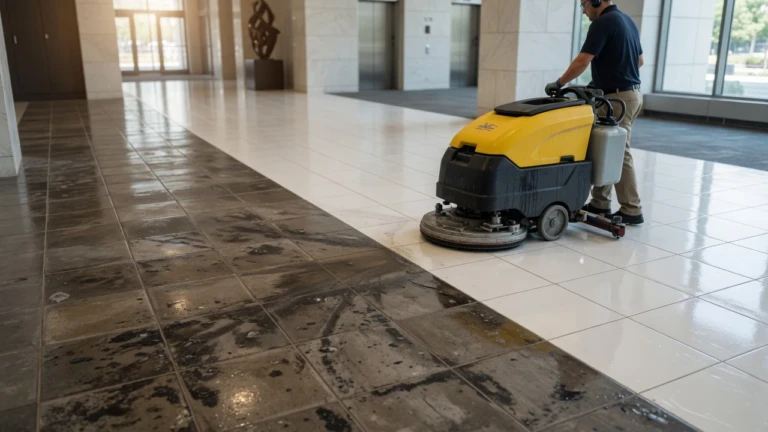
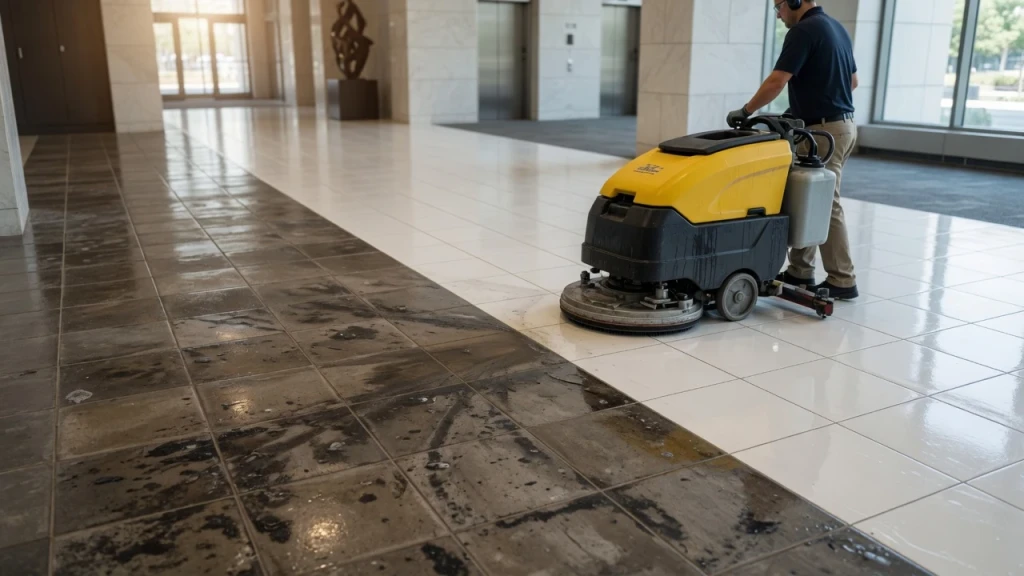
Grout is porous. Every mopping pushes a little dirty water into it, where it soaks in and stays. Over a few years, grout lines shift from their original color to grey, then brown — so gradually that nobody notices until a tenant, customer, or health inspector does.
Machine scrubbing with the right chemistry flushes the soil back out of the grout instead of driving it deeper. On most commercial tile, the color change is startling — the “before” and “after” look like different floors. Sealing the grout afterward is the step most vendors skip, and it’s the one that keeps the restoration from fading back within months.
The most expensive floor in your building is the one you replace because nobody knew it could be restored.
Concrete: stained isn’t structural
Warehouse and industrial concrete collects oil, tire marks, forklift scuffs, and chemical stains until the whole slab reads as grimy. But almost all of that damage lives in the top fraction of an inch.
Deep scrubbing and degreasing strip out the embedded oil and soil; from there, the slab can be maintained on a schedule that keeps it clean, brighter, and safer. Beyond appearance, there’s a practical payoff: clean, sealed concrete is easier to inspect for genuine cracks and damage, reflects more light (a real difference in warehouse lighting costs), and gives forklifts and foot traffic a more predictable surface.
Restore or replace: how to actually decide
A straightforward way to think about it:
- Restore when the damage is soil, stains, wear patterns, or dullness — anything that lives on or near the surface. That’s the overwhelming majority of “hopeless” floors we’re called about.
- Replace when the material itself has failed: carpet delaminating from the backing, cracked or loose tiles across large areas, concrete spalling or heaving.
An honest vendor will tell you which side of the line your floor is on before you spend a dollar. If someone quotes you a full restoration on a floor that’s structurally gone — or pushes replacement on a floor that just needs deep extraction — that tells you everything about who you’re dealing with.
What a restoration visit looks like
We walk the floor with you first — carpet, tile, or concrete — and test-clean a small area so you can see the result before committing to anything. From there it’s a straightforward scope: which areas get restored, in what order, on what schedule, and always outside your operating hours so your team never works around us.
Restoration is one piece of our full commercial floor care service — alongside stripping and waxing, buffing, and the ongoing maintenance plans that keep a restored floor from sliding back to where it started.
Before you sign a replacement quote
If there’s a floor in your building that everyone has given up on — in an office park in Torrance, a warehouse near the ports in Wilmington, or a facility down the coast in Orange County — get a second opinion before you pay to tear it out. The test patch costs you nothing, and the difference is usually the best money-saving surprise a facility budget gets all year.
Request a free walkthrough and we’ll tell you, honestly, what can be saved.