Your customers form an opinion about your business in about seven seconds — and most of that judgment happens before they ever reach your front desk. It happens at the curb, on the walkway, and at the front door. If that first stretch of concrete is stained with gum, oil, and a grey film of grime, you’ve already lost ground you didn’t know you were standing on.
Across the Harbor area, the South Bay, and into Orange County, that grime builds faster than almost anywhere else in the country. And it’s quietly costing local businesses customers every single day.
What a dirty entrance actually says
Nobody walks up to a storefront, notices a stained sidewalk, and consciously thinks “I will now spend less money here.” It’s faster and quieter than that. A grimy entrance sends a handful of signals straight to the part of the brain that decides whether to trust you:
- “They don’t sweat the details.” If the outside is neglected, customers assume the same about your service, your kitchen, or your warehouse floor.
- “This place might not be safe.” Oil slicks, black gum spots, and slick mildew read as hazards — especially to older customers and anyone carrying a child.
- “Business must be slow.” A tired exterior signals a tired company. Customers want to buy from a business that’s clearly doing well.
The frustrating part? The building, the team, and the service inside might be excellent. The entrance just never got the memo.
Why buildings near the ports get dirty faster
Sitting between the Port of Los Angeles and the Port of Long Beach is great for business and brutal on building exteriors. Three local forces team up against your curb appeal:
- Diesel and port traffic. Thousands of trucks moving through the twin ports kick up a fine, oily soot that settles on walls, walkways, and signage as a dull grey haze.
- Marine-layer moisture. That morning fog rolling in off the water feeds mildew, mold, and algae — the green and black streaks you see creeping up stucco and concrete.
- Salt air. The same coastal air that corrodes fleets leaves a sticky residue on surfaces that grabs onto dust and dirt and won’t let go.
A storefront along the coast genuinely gets dirtier, faster, than the same building a few miles inland. That’s not a knock on your housekeeping — it’s geography. It just means exterior cleaning here can’t be a once-every-few-years afterthought.
A clean entrance isn’t decoration. It’s the cheapest, fastest sales tool a local business has — and the only one that works on every customer before you’ve said a word.
The five zones customers judge first
When we walk a property with an owner, these are the spots that make or break that seven-second impression:
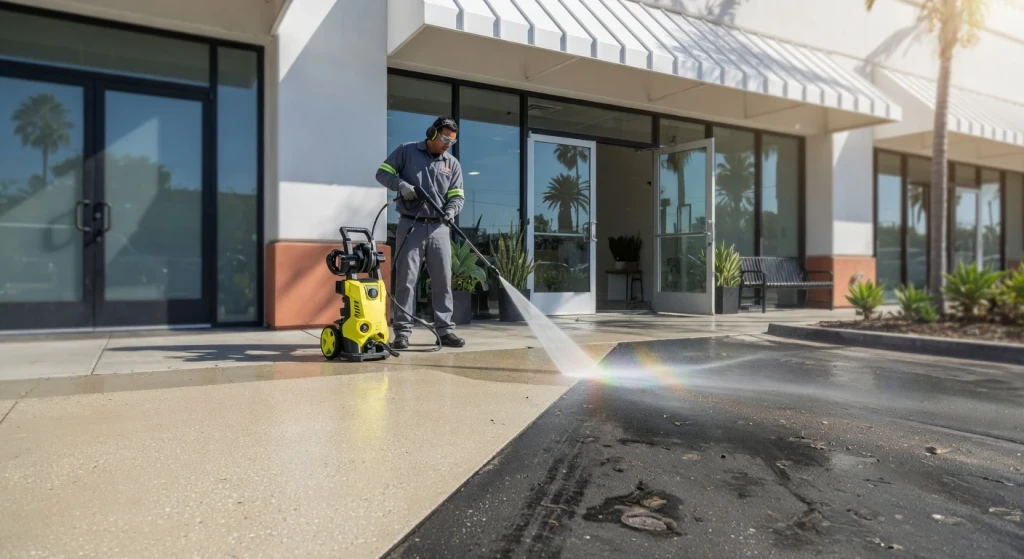
- The sidewalk and entry walkway. Gum, oil drips, and ground-in dirt — the most-walked and most-noticed surface you own.
- The building facade. Stucco, brick, or metal wearing a film of soot and mildew streaks.
- Entry doors and glass surrounds. Handprints and grime on the exact spot every customer touches.
- The parking area and drive lanes. Oil stains and tire marks that say “neglected” before anyone reaches the door.
- Dumpster pads and side alleys. Out of sight to you, but the first thing delivery drivers, inspectors, and back-entrance customers see.
One warning: pressure isn’t always the answer
It’s tempting to grab a pressure washer and blast everything in sight. Don’t. Too much pressure on the wrong surface will etch concrete, strip paint, crack stucco, and force water behind your siding — turning a cosmetic problem into an expensive repair.
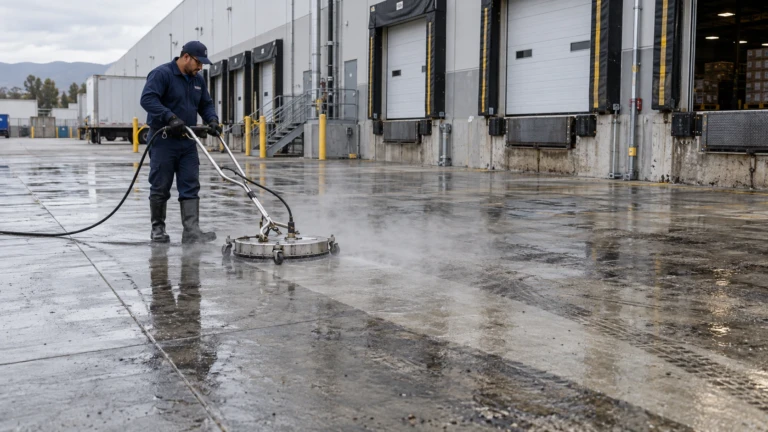
Different surfaces need different approaches. Hard surfaces like concrete and loading docks can take high pressure; delicate facades, painted surfaces, and anything with mildew need soft washing — lower pressure paired with the right cleaning solution that kills growth at the root instead of just blasting it off the top. Knowing which is which is the whole job. That’s exactly what our commercial power washing service is built around.
How often should you actually do it?
For most commercial properties along the harbor and coast, a realistic rhythm looks like this:
- Entrances and walkways: monthly to quarterly, depending on foot traffic.
- Building facades: once or twice a year to stay ahead of mildew and soot.
- Parking areas and dumpster pads: quarterly, or on a schedule that keeps you ahead of health and safety inspections.
The right answer depends on your location, your traffic, and how close you are to the water. A good cleaning partner builds the schedule around your property — not a generic package — and shows up on time, every time.
The bottom line
You’ve already invested in your space, your team, and your service. A grimy entrance quietly undercuts all of it for the price of a regular wash. Cleaning it is one of the highest-return, lowest-cost things a local business can do — and the only marketing that greets every customer at the door.
If you’d like a straight answer on what your property needs, we’re based right here in Wilmington and cover the South Bay and Orange County — happy to take a look. No pressure, no jargon, just a clear quote.