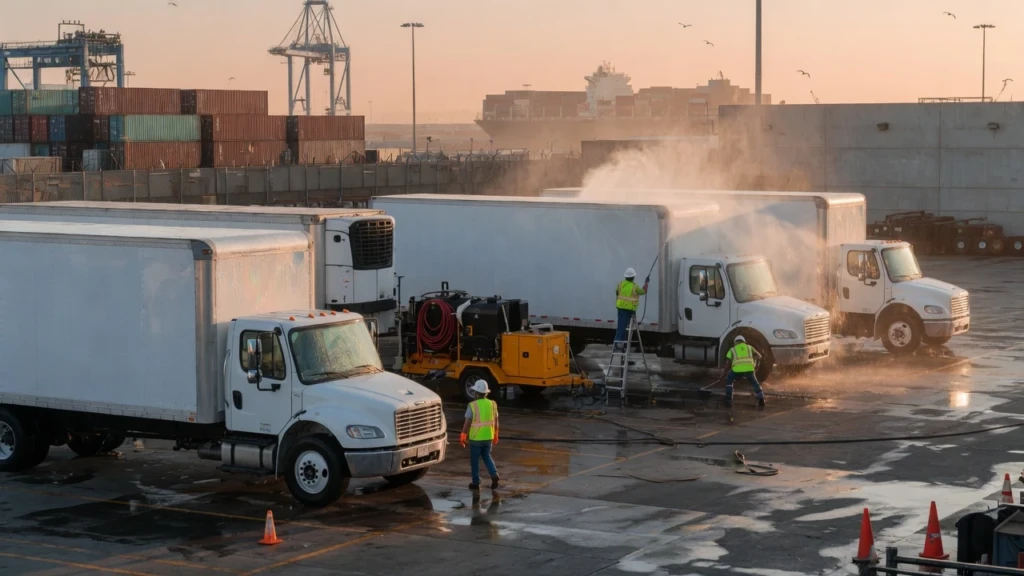
If your fleet runs routes near the Port of Los Angeles or Long Beach, your trucks are taking damage that fleets operating twenty miles inland never deal with. Salt air, diesel exhaust from thousands of port trucks, and marine-layer moisture combine into a corrosive environment that works on paint, metal, and undercarriage every single day — whether the vehicles are moving or parked.
Most fleet operators know their trucks look bad. Fewer realise how fast that grime is costing them money.
What port-area air actually does to a fleet
The twin ports push more container traffic than any other port complex in the Western Hemisphere. That means diesel particulate in the air at concentrations that settle visibly on surfaces within hours of a wash. Pair that with the salt air rolling in off the water and the morning marine layer that keeps everything damp, and you have three forces working together:
- Salt accelerates corrosion. It attacks bare metal, works under paint at chips and scratches, and gets into joints and undercarriage components. Trucks parked near the water corrode measurably faster than the same models running desert routes.
- Diesel soot bonds to surfaces. It is not just dirt — it is an oily film that grabs onto paint and holds other contaminants against the surface. A rinse does not remove it. The right chemistry does.
- Moisture keeps it active. The marine layer means surfaces rarely fully dry between washes. Damp grime is more corrosive than dry grime, and it works around the clock.
None of this is theoretical. Fleet operators who move from inland yards to port-adjacent operations consistently report faster paint degradation, more frequent undercarriage maintenance, and lower resale values on trucks that ran the same mileage as their inland counterparts.
The costs that show up on your books
- Resale value. A clean, well-maintained fleet commands significantly more at auction than one with oxidised paint and visible corrosion. For a fleet of ten trucks, that difference runs into tens of thousands of dollars over a typical replacement cycle.
- DOT and brand image. Dirty trucks attract more scrutiny at weigh stations. Clients who see your fleet at their dock form an opinion about your operation before anyone gets out of the cab.
- Undercarriage maintenance. Salt and road grime accelerating corrosion on brake components, frame rails, and suspension parts means earlier failures and higher repair costs. Regular washing — particularly underneath — is maintenance, not cosmetic.
A clean fleet is not overhead. It is asset protection — and near the ports, the environment makes it more urgent than almost anywhere else in the country.
Why on-site washing changes the equation
The traditional answer to fleet washing is an off-site truck wash: pull the vehicle out of service, drive it across town, queue behind whoever got there first, and drive it back. For a fleet of ten or twenty vehicles on tight dispatch windows, it is a logistics problem as much as a cleaning one.
On-site mobile washing eliminates that. We come to your yard — overnight, on a weekend, during the window between dispatch and the next morning departure — and the trucks never leave. No downtime, no driver time spent at a wash queue, no vehicles out of service during business hours.
For fleets operating out of Wilmington, Carson, Long Beach, or anywhere in the South Bay, that scheduling flexibility is usually the deciding factor. Our commercial fleet washing service is built around your yard and your timetable, not ours.
How often does a port-area fleet actually need washing?
- Drayage and port-facing routes: every one to two weeks.
- Regional distribution: every two to four weeks.
- Mixed or lower-exposure routes: monthly.
Undercarriage washing should happen at least monthly regardless of route type. It is the part customers never see and the part most vendors skip, but it is where salt air does its most expensive damage.
The bottom line
Harbor Cleaning & Maintenance operates out of Wilmington and serves fleet operators across the South Bay and Orange County. We come to your yard, work around your schedule, and handle the undercarriage — not just the sides. Get in touch and we will give you a straight answer on what a realistic wash schedule looks like for your fleet.