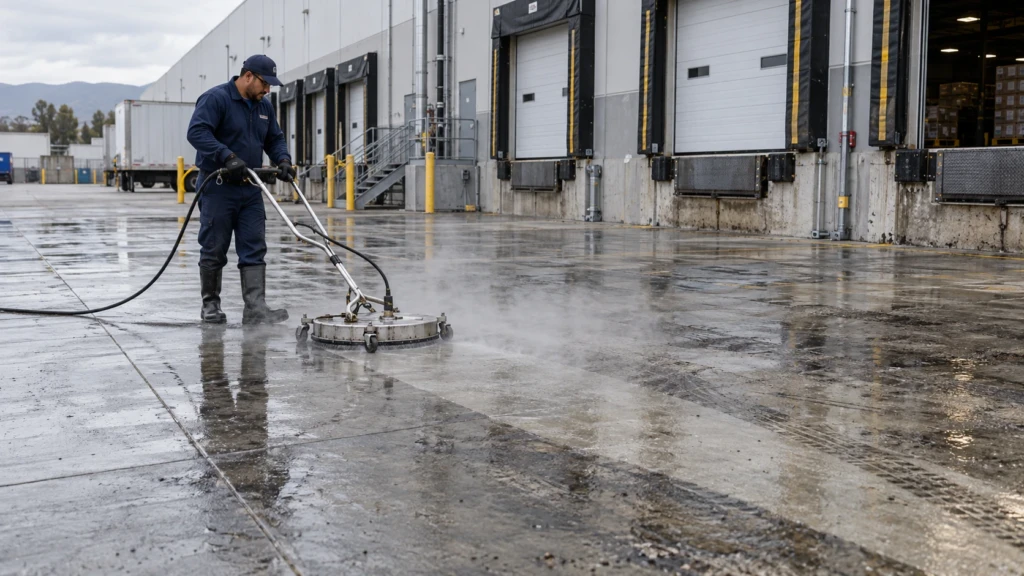
Your loading dock probably looks fine to you. You walk past it every day. You’ve stopped noticing the grease line along the dock bumpers, the grey slick across the drive lane, the dark ring spreading out from the dumpster pad.
Your health inspector hasn’t stopped noticing. Neither has the pest control company you called last quarter.
These are the zones most commercial cleaning programs quietly skip — and they’re exactly the zones that show up on violation reports, fail surprise inspections, and draw flies, rodents, and complaints from neighboring businesses. If you’re in the warehouse, logistics, food-adjacent, or hospitality space anywhere in the Harbor area or South Bay, getting this right isn’t optional. It’s compliance.
Why loading docks and dumpster pads are in a category of their own
Walk-in entrances get cleaned because customers see them. Lobbies get mopped because employees work in them. Loading docks and dumpster enclosures get cleaned when someone complains — or when an inspector shows up.
That cycle is exactly backward, because those zones accumulate more contamination, faster, than almost anywhere else on your property:
- Grease and hydraulic fluid drip from forklifts, trucks, and dock levelers and bake into concrete until regular mopping can’t touch them.
- Organic waste from trash compactors, food deliveries, and dumpster overflow sits in cracks and low spots, creating a food source for flies and rodents that no amount of bait stations fully controls.
- Tire rubber and vehicle exhaust leave a black film on drive lanes that gets tracked inside on wheels and boots.
- Standing water in dock recesses and around dumpster pads grows algae and bacteria — a slip hazard and a health concern at the same time.
None of this is about your team being sloppy. It’s about high-traffic, high-contamination zones that need a different level of cleaning than a mop and a bucket can deliver.
What actually happens during a health inspection
Los Angeles County Environmental Health inspectors aren’t grading on aesthetics. They’re looking for conditions that create pest harborage, food contamination risk, or safety hazards. In and around your loading and refuse zones, that typically means:
- Pest evidence — droppings, grease trails, gnaw marks on dock seals, harborage in debris accumulation around dumpster pads
- Grease accumulation — especially near dock levelers, compressor areas, and dumpster enclosures; a fire hazard and pest attractant
- Standing water or drainage failure — water pooling in dock pits or around refuse areas is an immediate flag
- Odor and organic buildup — inspectors note it; neighboring businesses complain about it
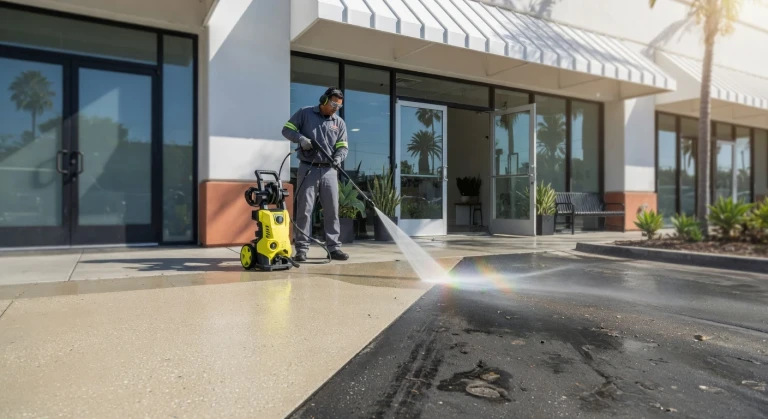
A pressure washing with the right degreasers and sanitizing agents knocks out the conditions before they become findings. That’s the whole point — inspections you pass cleanly, not ones you scramble to address.
The local factor: port traffic makes it worse
Facilities near the Port of Los Angeles and Port of Long Beach run more truck traffic through their yards than almost anywhere in California. That means:
- More diesel exhaust depositing on dock surfaces
- More hydraulic fluid and oil drips from heavy equipment
- More tire rubber grinding into drive lanes
The same marine-layer moisture that accelerates mildew on building facades also traps diesel particulate against flat concrete — turning a surface that should clean up in one pass into something that needs hot-water high-pressure work and a degreasing agent before a rinse will even bite.
Coastal South Bay facilities aren’t dealing with a typical dirt problem. They’re dealing with a combination of industrial traffic residue and ocean-air chemistry that most janitorial programs aren’t built for.
These zones accumulate faster than you think, and they don’t clean up with a garden hose. The properties that stay inspection-ready are the ones on a scheduled program — not the ones that call when it’s already bad.
What the right cleaning program covers
A proper pressure-washing scope for these zones isn’t a single blast-and-rinse. Here’s what it should include:
Loading docks and dock pits
- Hot-water high-pressure cleaning to break down baked-in grease and rubber deposits
- Degreaser applied to dock levelers, bumpers, and the pit floor
- Rinse and drain verification — water shouldn’t pool
Dumpster pads and enclosures
- Degreaser and sanitizing agent to kill bacteria and eliminate odors that attract pests
- High-pressure rinse of the pad, enclosure walls, and the drain area
- Grease trap area cleaned if accessible
Drive lanes and yard aprons
- Surface degreaser on oil-stained areas before pressure washing
- High-pressure wash of the full lane, focusing on the approach to dock doors
- Any standing-water drainage points cleared
A note on soft washing: dock concrete and asphalt drive lanes can take high pressure. If your dumpster enclosure has painted walls or a stucco surround, those need a lower-pressure soft-wash approach — blasting painted or textured surfaces causes more damage than it fixes. A good commercial crew knows the difference before they start.
How often do these zones actually need cleaning?
The honest answer depends on your operation, but here’s a practical starting point for South Bay and Harbor area facilities:
| Zone | Minimum frequency | Higher-traffic frequency |
|---|---|---|
| Dumpster pad | Monthly | Bi-weekly |
| Loading dock | Quarterly | Monthly |
| Drive lanes | Quarterly | Monthly |
Food-adjacent facilities — any operation that handles food products in receiving, prep, or distribution — should treat dumpster pads as monthly at minimum. Pest control alone won’t keep you compliant if the underlying contamination keeps rebuilding between visits.
The connection your pest control company isn’t telling you
Here’s something most facility managers find out the hard way: pest control and pressure washing work on the same problem from different angles. Bait stations and traps catch pests that are already on-site. Pressure washing removes the organic buildup, standing water, and harborage that draws them in the first place.
If you’re on a regular pest control program and still dealing with fly or rodent pressure around your refuse zone, the dock, or the dumpster area — the missing piece is usually a cleaning program, not more bait. Remove the food source, and the pressure drops.
Getting it done without shutting down your operation
The biggest objection we hear: “We can’t have the dock out of service.” Fair. That’s exactly why Harbor Clean schedules these jobs around your operation — overnight, weekends, or during your lowest-traffic windows. Our crews work around your schedule, not the other way around.
We’re based in Wilmington and cover the full Harbor area, South Bay, and Orange County. If you want a straightforward assessment of what your docks and refuse zones need — and a schedule that keeps you ahead of inspections — we’re happy to walk the property and give you a clear, no-obligation quote.
No surprises. No jargon. Just clean docks.
Ready to get ahead of your next inspection?
Get a free, no-obligation quote. We build a flexible schedule around your operation — power washing, janitorial, floor care, and fleet washing across LA County.
Get a Free Quote | Call 424-772-8580
Also see: One Vendor, Every Surface: The Case for Bundling Your Facility Cleaning